
The School of Participation as a practical example
The question we keep running into
In my work, a question comes up again and again: how do you measure processes between people and organisations when the learning cannot be captured by an indicator?
A few surveys at the beginning, middle and end won’t capture it either.
Think of longer-term learning journeys where many people, businesses or organisations are involved. Over months, participants gain many insights, some personal and some shared with the group. Some arrive in a workshop, others on the train home, others weeks later in their own practice. Each depends on the person’s context and on how they feel at that moment.
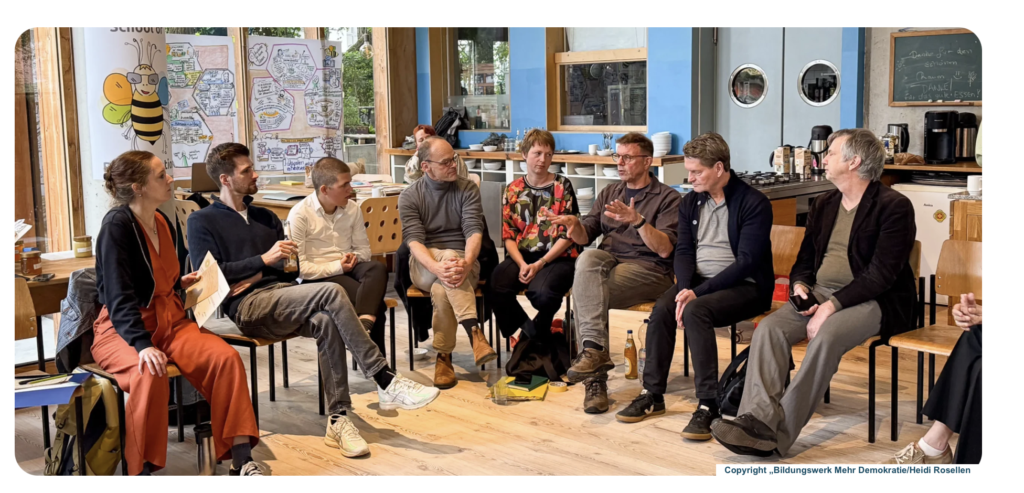
Moments like these are what the Sensemaker aims to capture.
People also learn from each other. They are mirrored by the group, by peers, by trainers, and that mirroring triggers new impressions and emotional states, which in turn shape what they learn next. So learning happens for individuals, in the group and in the organisations people come from, all at the same time.
In this kind of learning system, a fixed number of questionnaires says little. Questionnaires produce averages, and averages hide the turning points and the differences between people.
Understanding learning processes needs many voices over time
Better questions alone won’t solve this. It depends on what we are trying to judge, and who is able to judge it.
To see why indicators fall short, it helps to ask what kind of situation we are looking at. The Cynefin framework, developed by Dave Snowden (whose work also gave rise to Sensemaker), distinguishes between ordered and unordered systems. Interestingly, a single learning journey or a course touches all of them.
In ordered systems, cause and effect can be known in advance:
- Clear: the connection is obvious to everyone. In a course, this is the organisational side: did participants register, log in, attend the sessions, hand in the assignment? A checklist or attendance list answers these questions reliably.
- Complicated: cause and effect exist, but you need expertise to see them. In a course, this is whether participants have understood a concept or can apply a tool correctly, for example a stakeholder analysis or a facilitation method. A trainer can design a good test or review an assignment and judge the result. Here, indicators and expert assessment work well.
In unordered systems, there is no fixed connection between cause and effect that you could know beforehand:
- Complex: many people influence each other, and patterns emerge from their interactions. In a course, this is where much of the real learning happens. A remark from a peer during a coffee break changes how someone sees their own role. A tense moment in the group makes one participant withdraw and another speak up for the first time. An insight only lands weeks later, when someone faces a difficult situation in their own work. The same session can mean something very different to two people. Nobody can plan this or predict it; we can only notice it when it happens, and understand it afterwards.
- Chaotic: there are no recognisable patterns, and the first task is to act. In a course, think of a live session where the technology fails completely, or a group conflict that suddenly escalates. The trainer has to step in and create stability first; reflection comes later.
Most evaluation tools are built for the ordered parts: attendance, completion, test results. They are useful, but they miss the complex core of a learning journey: how people change their attitudes and their practice through each other. An indicator assumes we know in advance what “good learning” looks like and where it will show up. In this part of the course, we don’t. So what we need is not a judgement measured against a target, but a picture of the patterns that emerge.
That is why we work with micro-narratives. Instead of asking participants to rate the programme on a scale, we invite them to share short experiences regularly, for example about a moment that moved them or an exchange that irritated or inspired them. A few sentences are enough.
This is the foundation of Sensemaker, a software-based method developed in the field of complexity thinking. It works in three steps:
- Sharing: Participants enter short experiences continuously, across the different phases of the process.
- Self-interpretation: Participants then interpret their own story through a set of questions, for example by placing it in triangles or between two poles. Interpretation stays with the people who had the experience, not with an external evaluator.
- Pattern-making: The more micro-narratives are collected, the more an overall pattern emerges: a landscape of impressions, with clusters, outliers and shifts over time.
We then share these patterns with the participants, who look at them together and discuss whether and how they recognise themselves. The evaluation becomes part of the learning process itself.
What this looks like in practice
At Mesopartner, my colleagues and I use Sensemaker in different contexts: to accompany change processes over time, to run broader inquiries, and to pick up things that standard monitoring usually misses.
My current project is a Sensemaker for the second cohort of the School of Participation, a year-long training programme for people who design and facilitate participation and democratic processes. We want to understand how participants experience the learning journey: where learning happens, what supports or blocks it, how the group shapes individual development, and how insights travel into people’s own practice.
Imagine an in-person meeting of the School of Participation. Afterwards, three participants share a short experience each (fictional examples):
- One describes a moment in the group dynamics that moved him deeply and challenged him: a conflict in the group that was named openly and then worked through together.
- Another describes an insight she gained from a session in which a new method was introduced. It changed how she thinks about involving quiet voices in a process.
- A third describes a practical exercise that was particularly valuable for his own work, because he could try out a difficult facilitation situation in a safe setting.
Each person then interprets their own story using a set of questions, called signifiers. Some are triads: triangles with three possible answers at the corners. Others are dyads: sliders between two poles. Both work the same way: the person places their story where it fits, and nobody else decides where it belongs. Below are some examples of triads to explain the logic. One triad asks: What shaped this experience? The three corners are heart/emotion, head/insight and hand/practice. The first participant places his story close to “heart”, the second close to “head”, the third close to “hand”. Mixed experiences land somewhere in between. Nobody else decides where a story belongs; the person who lived it does.
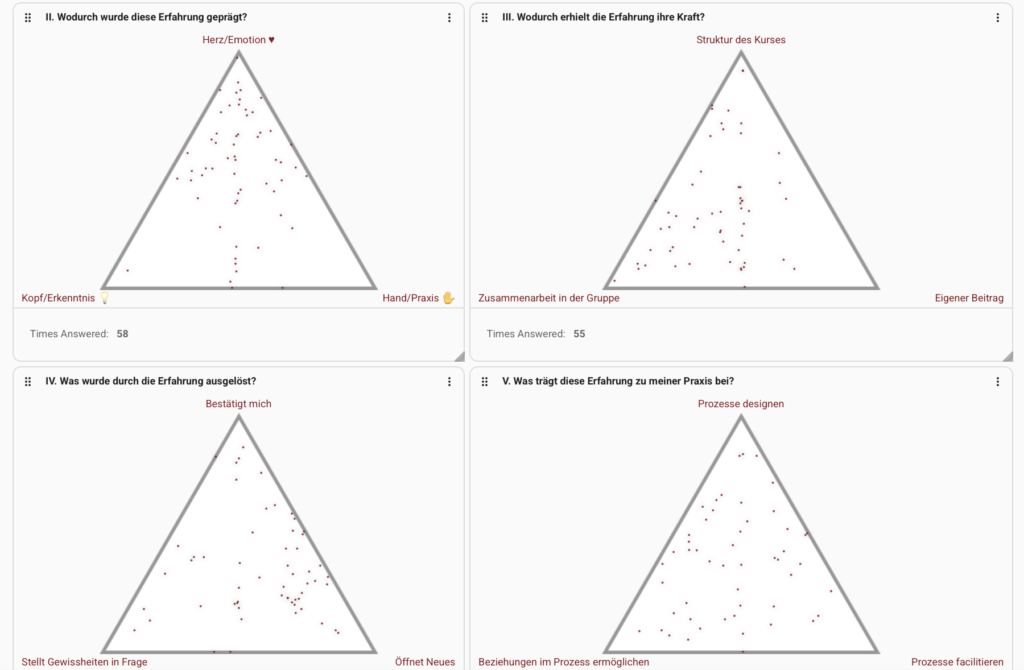
what shaped the experiences, what they triggered, and how they feed into practice.
A second triad asks: What did this experience trigger? The three answers are it confirmed me, it opened something new or it challenged my certainties. A third and fourth triad ask where the experience drew its strength from (course structure, group collaboration or my own contribution) and what it adds to my practice (designing processes, facilitating processes or enabling relationships within the process).
Behind every dot is a micro-narrative from a participant. A single dot tells you little. But as dozens of stories come in, patterns appear: where the dots cluster, where they spread out, which corners stay empty. And because every story is placed on several triads, the patterns can be combined. For example, do the emotionally powerful experiences also open something new? Do insights from the course structure find their way into practice? Together, the triads form a picture of the learning journey that no single questionnaire could provide.
What remains challenging
Two things remain challenging. The first is trust: even though the data is stored securely and cannot be accessed from outside, some people hesitate to share personal experiences. The second is participation: sharing and interpreting a story takes only a few minutes, yet motivating a larger group to make this extra effort, again and again, takes ongoing encouragement and visible use of what they share.
Ways of using SenseMaker
Sensemaker can be used in different ways.
Accompanying a process over time. Here, the same group of people shares experiences again and again over weeks or months, for example during a training programme, a change process in an organisation, or a regional (economic) development initiative. The focus is on how things develop: which patterns become stronger, which fade, where something shifts. Because the patterns are mirrored back to the participants along the way, the Sensemaker becomes part of the process itself. It supports reflection and helps steer the next steps.
Capturing a picture of the moment. Here, Sensemaker is used once, as an inquiry or a snapshot of views. Many people share an experience on a specific topic at one point in time. For example, residents of a region share how they experience their local economy, employees share what helps or hinders cooperation in their organisation, businesses share uncertainties that affects their way forward strategy or stakeholders share their view of a policy or programme. The result is a broad picture of how a situation is experienced from many perspectives, including the differences between groups and the voices that would otherwise go unheard.
Both uses share the same principle: people tell their own stories and interpret them themselves, and the meaning emerges from the patterns across many stories. At Mesopartner we use both, depending on the question at hand. For the second cohort of the School of Participation, I use the first: accompanying the learning journey over the full year.
Some principles
From our experience, a few principles help when evaluating learning processes between people:
- We don’t design a Sensemaker on our own but together with the people it is meant for, because they know which experiences matter and which words fit
- Collect many small experiences rather than a few big judgements. You only see patterns once you have many different stories.
- Collect over time, not only at fixed points. Learning doesn’t follow a schedule, and when a story is shared also tells you something.
- Let people interpret their own experiences. This reduces evaluator bias and takes participants seriously as experts on their own learning.
- Mirror the patterns back. Participants, trainers and organisers often learn the most when they discuss the results together.
- See evaluation as part of the process, not as a check after it. If it is done well, evaluation also supports the learning it observes.
Over to you
How do you capture the learning in your programmes that no indicator can show? Thanks for sharing your experience.
If you are thinking about using Sensemaker to accompany a learning journey, a change process or an inquiry of your own, feel free to get in touch, and we’d be glad to design it with you.