Initial Reflections from Practice
In our work on local and regional transformation processes, we primarily focus on economic structures and the actors involved. This includes economic mappings of sectors, value chains, markets, support service providers, as well as actor mappings of organisations and their network relationships.
As part of a training seminar at the School of Participation, I had the opportunity to experience theatre-based methods and democratic systemic constellations. Both approaches aim to enhance the emotional perception and power-related considerations of systems, thereby enabling a deeper understanding (see LinkedIn posts and photos).
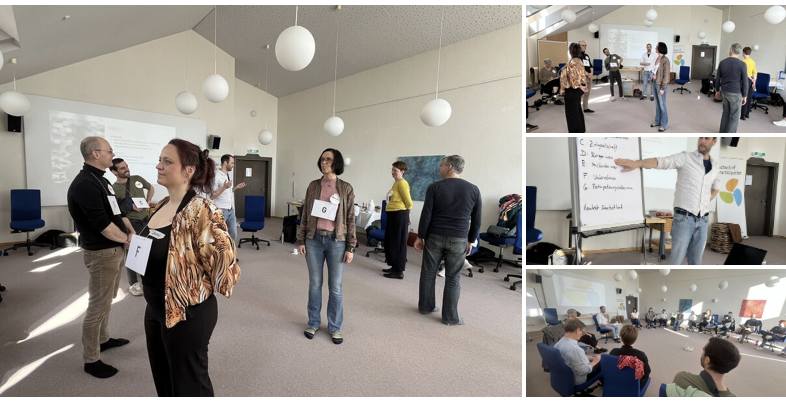
(Many thanks to Josef Merk for his seminar on democratic constellations and to the Laboratory for Theatre and Society for raising awareness of these perspectives.)
This made me realise that what is often missing in our mappings is the question of how humans and actors actually experience their situation. Many of the dynamics we observe in projects cannot be explained by data, structures, or the mapping of existing relationships alone. In many regions, there is something tangible yet difficult to grasp: uncertainty, hesitation, sometimes even mistrust.
We are familiar with situations where processes do not really gain momentum—where externally initiated initiatives can feel like a foreign body because they are not truly carried from within. Strikingly, this dimension is rarely explicitly addressed, even though it significantly influences how decisions are made and whether collaboration emerges at all.
Democratic constellations (as expressed by Josef Merks) aim to make feelings perceptible. Feelings are a central element of relationships. When we become aware of them, the information they contain becomes accessible—along with a deeper sense of how relationships are experienced. This, in turn, can open up new, collective possibilities for action at the local level.
This raises a very practical question for me: How can we systematically integrate the perception of feelings—and their translation into meaningful information and new possibilities for action—into our analytical processes?
Two initial approaches come to mind that I would like to explore further:
1. Adding perception-oriented questions to field interviews and analysis
Our established analytical approaches on markets, networks, potentials, and sustainability aspects are very valuable. We can complement them with questions that focus more on emotional impressions and perceptions.
Some example questions:
- What currently concerns you most when you think about the future of your region or your business?
- Where do you currently experience openness for collaboration—and where more hesitation? Are there actors whose positioning you are uncertain about?
- Which topics currently generate energy—and which rather resistance?
- With which actors would you like to collaborate more closely? Where do you see real opportunities?
These questions change the nature of the conversations. They provide additional insights. You not only understand what is happening, but also gain a better sense of how situations are experienced. Often, this helps to better explain dynamics that previously remained rather diffuse.
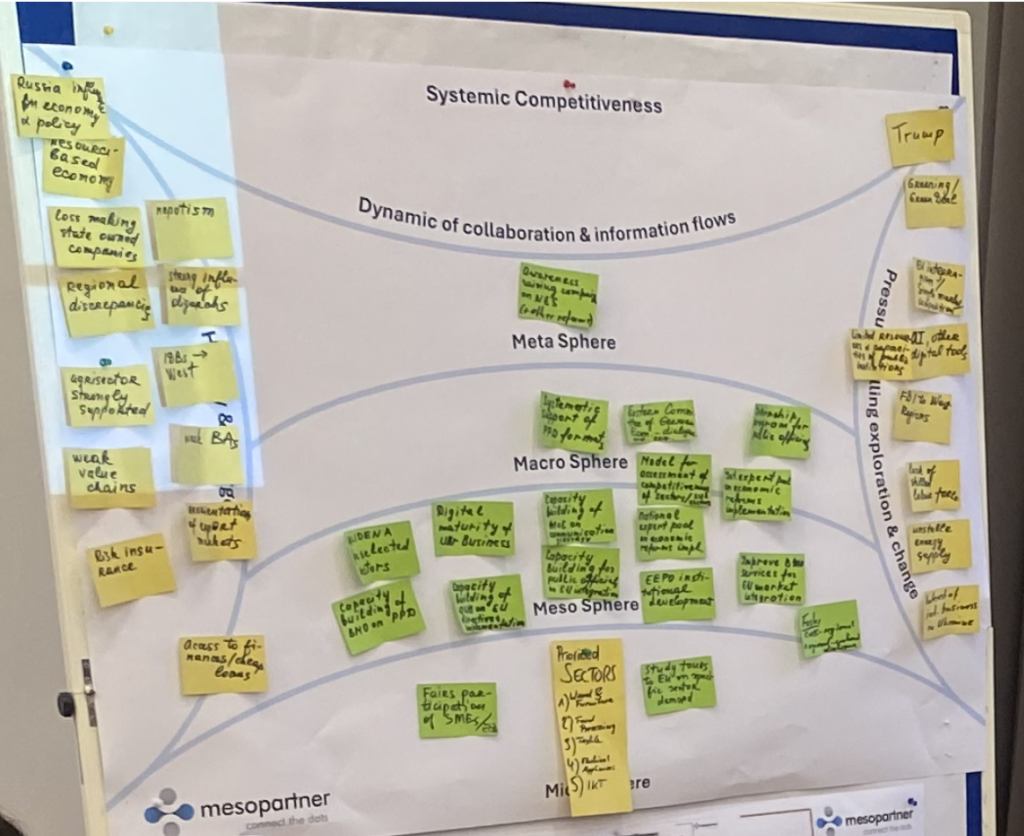
Sysco Map with card reflections
2. Simple constellations in workshops with key local partners or within the team
This workshop format involves conducting a joint constellation exercise with a carefully selected, trusted group of partners, based on the Systemic Competitiveness (SysCo) analytical framework. After an initial mapping of actors (e.g. using cards or post-its along the model-see photo above), we focus specifically on what is happening between them.
We ask questions such as:
- What influences or might influence behaviour here without being directly visible?
- What is really going on in the background or what might really go on?
- What creates or seems to create a sense of security—and what does rather not?
To deepen reflection on the emotional dimension and on how actors perceive the current reality, a second round of the workshop could introduce simple constellations—using figures (see photo below) on a table or, depending on the group, by positioning participants in the room. This approach helps explore relational dynamics and how actors perceive one another.
The aim is not to represent reality “correctly,” but to develop and reflect on hypotheses, making underlying perceptions visible and unlocking insights that can open up new options and perspectives.
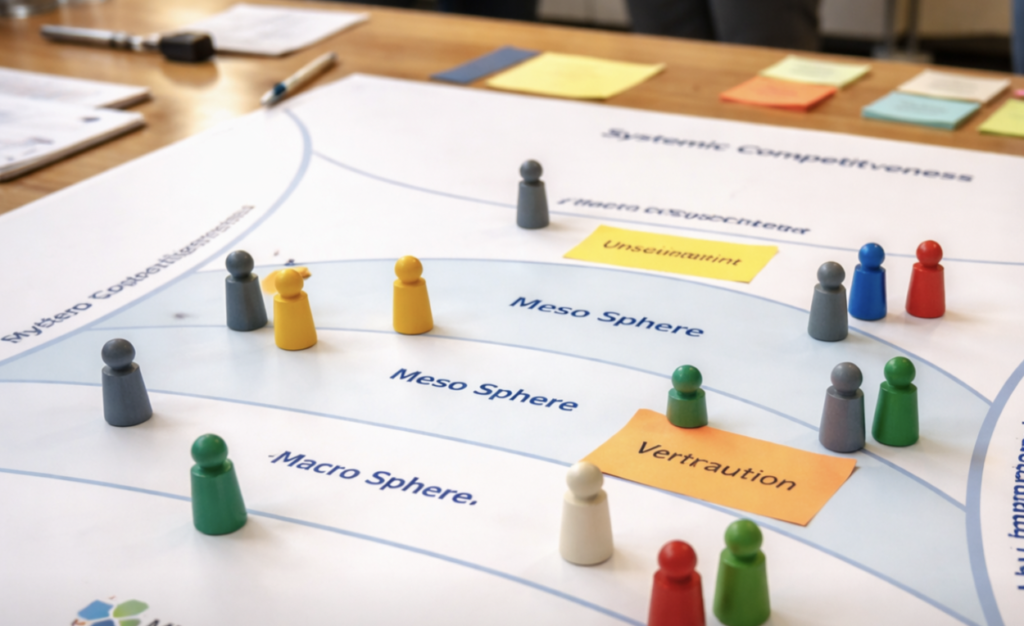
Sysco Map as constellation with figures to explore and reflect on the emotional state of a system.
Typical reflection questions include:
- From your first impression, how do these actors relate to one another?
- Where do you perceive closeness or distance? Where does the space feel open, and where do tensions emerge?
- What stands out or surprises you in this picture?
To further develop hypotheses and reflect about options, we introduce two guiding questions, which participants respond to from their respective positions.
- Could it be that…?
- If that were the case, what would need to follow?
The hypotheses and options that emerge from this process are documented and subsequently explored and validated in the analysis phase.
I tested this approach in an initial practical example and was struck by how quickly tensions, perceptions, and additional options surfaced—considerations that had not been articulated before.
3. What do I take away from this?
Alongside the economic and social “maps,” there is always a third dimension. The emotional map is more difficult to grasp, but it is clearly needed to better understand what is going on. Transformation processes are not only about developing good solutions, but also about understanding the emotional state a system is in—and how these emotions become information, once they are becoming expressed, that again can lead to collective possibilities for action.
I am not yet sure how to systematically integrate this perspective into our work.
But it feels like an important next step. I would like to further test different ways and instruments. If you have already worked with emotional maps or developed your own tools in this area, I would be very interested in exchanging experiences.