
From Thematic Green Agendas to Integrated Regional Strategies
Cities and regions are often described as the key implementation layer for green and economic transformation. But what does that actually mean in practice?
If we take this idea seriously, then place matters in a fundamental way. It is not only the location where policies are implemented, but the context that shapes what is possible—through its economic structures, its networks, its capabilities, and also its social dynamics.
For quite some time now, I have been looking for green regional strategies that take this seriously—approaches that are genuinely bottom-up and that combine the different layers needed to develop a region that is both competitive and oriented towards quality of life for its cities, SMEs, and communities.
What I was searching for was not another thematic strategy (such as a regional Circular Economy Strategy), but an approach that responds to the real complexity of challenges and opportunities a region faces.
In the following, I will share some observations from this search, as well as a first insightful case.
A dominant pattern: strong initiatives, but often thematic
Looking across the current landscape, many regional strategy initiatives have emerged in the context of the European Green Deal. Many of them have created important momentum. At the same time, they often follow a similar underlying logic:
- Many of these initiatives are not primarily driven by bottom-up regional dynamics, but rather by predefined thematic priorities that are then translated into regional contexts.
- There exists a wide range of platforms such as circular regions, circular cities, circular rural areas, climate-neutral cities, and energy cities, each of which focuses on a specific dimension of transformation (e.g. energy) or a specific target (net zero) within a place or territory, less so on the combination of the dimensions.
- While these thematic approaches are valuable in creating focus and expertise, they often remain somewhat fragmented when seen from a regional development perspective.
- In many cases, there is limited attention to how these themes overlap, interact, and need to be combined within a specific regional context in order to become effective.
What is often missing is a more integrated perspective that asks how different transformation agendas can be brought together in a coherent regional development pathway.
The challenge: moving from themes to regional systems
Regions are not organised along thematic lines. They evolve through the interaction of multiple elements: They are shaped by existing industries and clusters, which define starting points and transformation pathways. They are also shaped by networks between firms, knowledge institutions, and public actors, which enable coordination and collective action. Existing local capabilities and skills strongly determine how transformation processes can actually be absorbed and implemented.
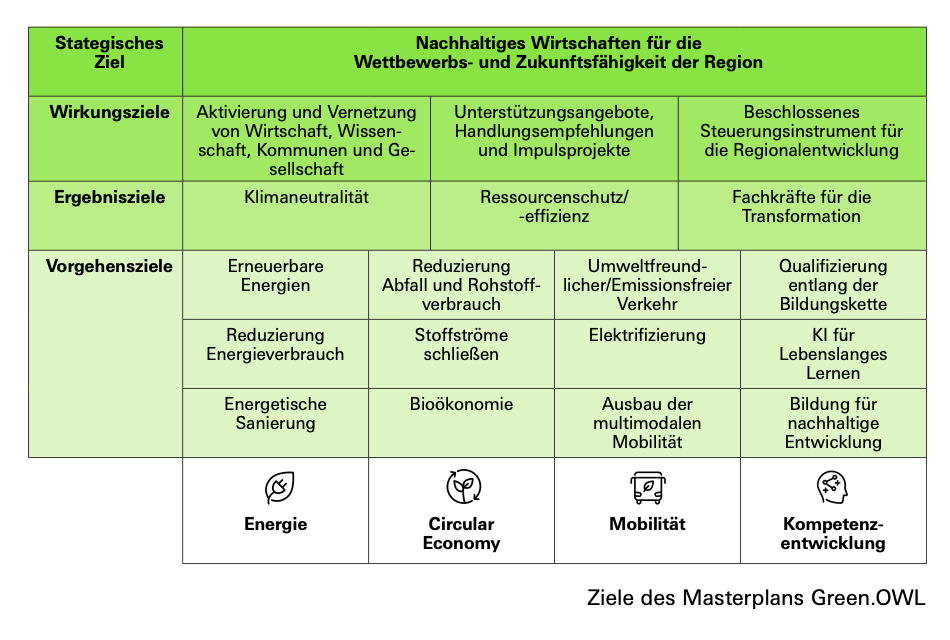
The table above shows the overall Masterplan objectives with their vertical and horizontal combination of green themes.
Last but not least, people and organisations in a region are embedded in social and territorial dynamics that influence their willingness to participate, the feeling of belonging, and their capacity to act as drivers of transformation.
If green regional strategies remain within thematic silos, they risk missing these interdependencies.
What seems to be needed instead is an approach that:
- Connects themes horizontally across sectors and policy fields, rather than treating them in isolation.
- Links them vertically along value chains, competencies, and technological pathways.
- Builds on the region’s specific strengths, experiences, and existing dynamics.
A different experience: the Green Masterplan OWL
Against this background, I recently came across the Green Masterplan OWL. What struck me was not a single innovative element, but the way in which different aspects are brought together into a more coherent approach.
Several elements seem particularly relevant.
- The strategy is based on a strong bottom-up process, in which regional knowledge organisations and research institutes are not only involved as stakeholders, but actively contribute to building the analytical foundation, shaping methodologies, and designing monitoring approaches.
- It builds on existing economic structures, especially long-standing cluster initiatives and regional networks, thereby anchoring reflection processes on green transformation requirements in established forms of cooperation and experience.
- It combines different thematic areas both vertically and horizontally, for example by linking circular economy, bioeconomy, and waste along value chains, while at the same time connecting energy, mobility, industrial transformation, and skills across sectors.
- It connects dimensions that are often treated separately, including competitiveness and future viability, learning and skills development, technological change, inclusion through education and participation, and clearly defined sustainability goals.
- It makes use of participatory and implementation-oriented instruments, such as maturity models for assessing and monitoring regional progress, scenario processes with strong stakeholder involvement, the identification of pioneer actors, and a combination of lighthouse projects with smaller, quickly implementable initiatives that help to create momentum.
What emerges from this is not a collection of themes, but something closer to a systemic view of regional transformation.
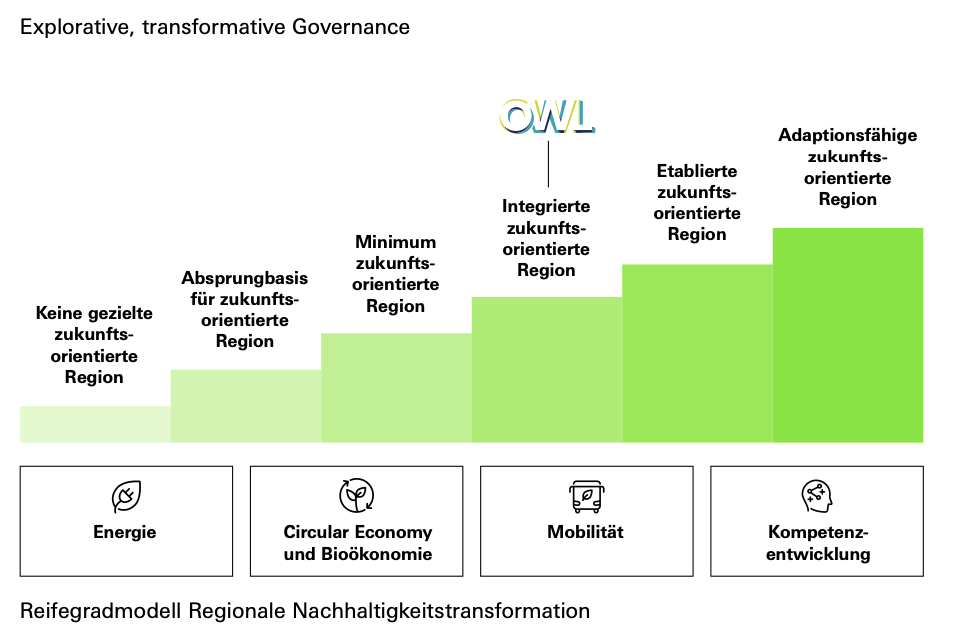
The Regional Sustainability Maturity Model developed by the University of Paderborn classifies the different stages of progress that regions achieve in implementing their sustainable development strategies.
Towards more integrated regional transformation strategies
From my perspective, this is one of the first approaches I have seen that seriously attempts to move from thematic green initiatives towards more integrated, context-related regional transformation strategies.
What is relevant is that we treat the green transformation in regions and locations not simply as a set of topics, but as a systemic regional development challenge that requires coordination across multiple dimensions.
Questions I want to further explore
- How can we move beyond thematic approaches towards more context-driven, integrated regional strategies that reflect the realities of specific places?
- What other insightful international examples exist of implementation-oriented green regional strategies?
- How are strategies such as the one in OWL actually implemented in practice? What challenges emerge on the ground, and what can be learned from them?
- And what kinds of processes and instruments can we further explore and share to facilitate these transformations in a more participatory and agency-building way?
I will continue to explore cases in more detail over the coming weeks and would be very interested to hear about other examples and to exchange with others working on these questions.